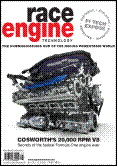
Race Engine Technology Issue 73
Special Investigation:
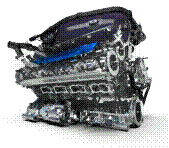
THE COSWORTH CA 2.4 litre V8 Formula One engine
In the current issue (#73) of Race Engine Technology magazine, Editor Ian Bamsey reports in
astonishing detail on the first Formula One engine to reach 20,000 rpm on
track.
From 1906 through to 2006, Grand Prix engine speeds
rose ever higher, from less than 2000 rpm to ultimately a mind-boggling 20,000
rpm. Then the rule-maker abruptly halted the march of progress with a 19,000
rpm rev limit for 2007, subsequently reduced to the current stifling 18,000 rpm
– plus, to add insult to injury, a moratorium on development. While engine
evolution is back in 2014, the emphasis henceforth will be fuel efficiency
rather than outright, untrammelled performance. The glorious Century of Speed
is over.
The first Formula One engine to attain 20,000 rpm on
track was the Cosworth CA of 2006, and it is
generally agreed that no rival surpassed it as the benchmark before rev
limiting was cruelly imposed. These days the naturally aspirated 2.4 litre V8
CA lives on, powering Marussia in its close fight
against Renault-engined Caterham for the honour of
top dog of the young teams in Formula One. Remarkably, although the CA is still
on active duty, Cosworth has given RET full access to
the innermost secrets of Grand Prix racing’s all-time engine speed champion.
Operating speed and
horsepower steadily climbed during much of the 3.0 litre V10 era preceding the
switch to V8s mandated for 2006. It is widely agreed that BMW reached 19,000
rpm first, in 2002. However, engine mileage requirements were lengthened in
2004 and 2005, which had the effect of pegging the ongoing
crankshaft speed rise. Representative of the top 2005 V10s was the Toyota that
ran to a maximum of 19,200 rpm and produced an estimated 930 bhp mid-season. All of the 2005 V10s exceeded 900 bhp but it is not thought that any exceeded 950 bhp, with the possible exception of the Honda at the end of
the season.
Cosworth’s 2005 V10 was the TJ, which had its red line at 19,000
rpm. Indeed, it had taken a relatively long time for the Northampton virtuoso
to rise above 18,000 rpm with its V10s. Nevertheless, with the CA it took the
uncompromising approach of targeting 20,000 rpm from the outset. This was the
first time it had produced such a high-speed V8 – the previous fastest running
of the type had been its XF IndyCar engine, which ran
to 16,250 in qualifying back in 2002 (immediately before the switch to a Cosworth-supplied spec engine for the CART series).
By regulation, the CA retained the per-cylinder
displacement of the existing 3.0 litre TJ V10, which had a 95 mm bore. As Cosworth’s technical director Bruce Wood remarks, “To go faster
you just have to keep making the bore bigger, the stroke shorter and sort out
your valves...”
Of course, that is easier said than done and RET’s
exclusive article on the CA explains in great detail, all the factors involved
in the design and development of the 20,000 rpm version of 2006 and the
subsequent ‘frozen engine formula’ derivative still in use this season. For
example, running an engine faster increases friction, potentially to an extent
that counteracts the sought after horsepower gain. Means Cosworth
developed to counter this drawback even included applying a Diamond-Like Carbon
(DLC) coating to the piston skirts.
At 20,000 rpm the CA’s maximum piston acceleration was
10,616 g while the load imparted on each crankpin by the associated piston and
con rod reached a very substantial 5937 kg at that unprecedented speed. To put
that into context, an anti-ballistic missile attains a g-force
of only 100 g while 5937 kg is approximately two and a half times the weight of
a Rolls Royce Wraith!
Race Engine
Technology’s full report of the Cosworth CA, in issue 73, spans 27 pages and is a must-read
for all involved with racing technology. Indeed, it is almost certainly the
most incisive report of any engine discussed in the motorsport media since
Grand Prix racing barked into life more than 100 years ago!
Race Engine
Technology issue 73 can be bought
from www.highpowermedia.com or by
calling Chris Perry on +44 (0)1934 713957.